Somewhere in an office break room right now, there’s a drawer stuffed with cheap pens that skip, a stack of stress balls no one has touched since the trade show three years ago, and a tote bag so flimsy it tore the first time someone put groceries in it. Every single one of those items has a logo on it. None of them are doing a thing for the brand that paid to put it there.
Promotional products can be one of the most cost-effective marketing tools in a business’s arsenal, or they can be a reliable way to light money on fire and end up in a landfill. The difference isn’t the budget. It’s the thinking behind the order.
Today, the team here at Davant Indy is giving you an honest look at what belongs in the promotional products graveyard and what’s actually worth investing in. By the end, you should know exactly what to order next to avoid wasting money!
The Items That Almost Always Disappoint
Cheap pens are the original promotional product sin. Everyone orders them because they’re inexpensive and feel universally useful. And they are useful, right up until the ink runs out or the clip snaps off, which usually happens within a week. At that point, your logo goes straight into the trash. If you’re going to put your brand on a pen, spend a little more and get one that writes well and feels solid in someone’s hand. The ones people actually keep are the ones worth keeping.
Additionally, stress balls, foam items, and novelty shapes had their moment roughly fifteen years ago. They’re not inherently bad, but they’ve become so associated with trade show giveaway bins that most people’s eyes slide right past them. There’s no longer any novelty in the novelty item.
Furthermore, generic tote bags are another trap. The market is so saturated with them that recipients barely register what’s on the outside anymore. They pile up, get used once, and eventually become the bag inside a bag inside a bag in someone’s closet. That said, a well-made, distinctive tote with a thoughtful design is a different story—more on that in a moment.
Finally: anything so branded it’s unwearable. A neon shirt with a logo covering the entire front, a hat with a five-inch embroidered patch, and a jacket that looks like a walking advertisement. Branded apparel works when people actually want to wear it. If the branding is more prominent than the product is comfortable, it goes into a donation pile or stays in the closet permanently.
What Recipients Actually Hold Onto
The items that stick around have one thing in common: they’re genuinely useful in everyday life. Not marginally useful, not situationally useful—actually, repeatedly useful in a way that makes the recipient glad they have it.
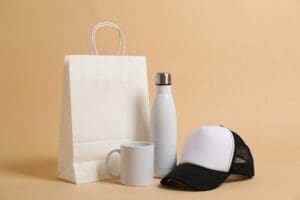
Quality drinkware consistently tops the list. A well-made insulated tumbler or travel mug is something people use every single day. It sits on their desk, it rides in their car, it goes to the gym. Every time they reach for it, your brand is there, not in an intrusive way, but in a familiar, comfortable one. That’s exactly the kind of repeated exposure that builds recognition over time.
Notebooks and journals with good paper quality have made a real comeback. With so much of daily life happening on screens, something tactile and analog tends to stand out. A hardcover notebook with clean branding feels like a gift, not a giveaway. People use them through to the last page.

Tech accessories (good ones, not the bargain bin, 5 Below variety) are consistently well-received. Charging cables, power banks, wireless chargers, and earbuds all fall into the category of things people need and use constantly. Slap a cheap version of any of these in someone’s hands, and they’ll lose it quickly. Give them a quality one, and they’ll keep it for years, logo and all.
Wearables that don’t scream “corporate giveaway” are worth the investment. A hat or quarter-zip in a color people actually want to wear, with understated branding, gets worn in the real world. When that happens, your brand is walking around in front of people who’ve never heard of you. That’s the whole idea.
The Real Question to Ask Before You Order
Before finalizing any promotional product order, it helps to ask one honest question: Would I actually use this? If the answer is a hesitant maybe, that’s usually a no.
It also pays to think about your specific audience. A tech company handing out branded USB hubs to developers is speaking directly to what that audience actually needs at their desk. A construction company giving away high-quality work gloves with their logo to contractors understands who they’re marketing to. The more targeted the item, the more likely it is to be used and appreciated.
Budget matters, but it’s not the whole story. Fifty mediocre items that end up in the trash cost more in the long run than twenty quality items that people actually keep. The math on promotional products is really about cost per impression over the life of the item, and quality items deliver far more of those impressions than cheap ones do.
Where Davant Fits In
Sourcing promotional products that are actually worth ordering takes access to a wide catalog and some real knowledge of what works. At Davant, we work with businesses throughout Greenfield and the Indianapolis metro to find items that fit their brand, their audience, and their budget without defaulting to the same tired options everyone else is handing out.
Whether you’re gearing up for a trade show, putting together a client gift, stocking up for an event, or just looking to refresh what you’ve been ordering, we can help you find something that actually earns its keep.
Ready to Order Something People Will Actually Keep?
Let’s talk about what makes sense for your business and your audience. We’ll help you skip the promotional product graveyard and find something worth putting your name on.
Contact us online or give us a call at (317) 849-6565 to get started.