What You Need to Know Before You Order
If you’ve ever watched a banner go from crisp and vibrant in May to faded and curling at the corners by August, you already know that not all outdoor signage is built for an Indiana summer. The Midwest has a particular talent for punishing materials that weren’t designed for our climate, especially the brutal heat, high humidity, sudden storms, and UV exposure that don’t let up for months at a time.
The good news is that with the right materials and the right production choices, outdoor signage can hold up beautifully through an entire season and well beyond. The key is knowing what to ask for before you order, not after you’ve replaced something that wasn’t built to last.
Here’s what businesses in Greenfield, IN, and beyond need to know when it comes to outdoor signage that actually goes the distance.
Why Indiana’s Climate Is Harder on Signage Than You’d Think
Indiana sits in a climate zone that doesn’t get much credit for being extreme, but it absolutely is, just in a slow, grinding way rather than a dramatic one. Summer temperatures in Greenfield regularly reach the upper 80s and 90s, and direct sunlight on a dark-colored sign face can raise surface temperatures significantly above the air temperature. Over weeks and months, that heat breaks down inks, warps substrates, and degrades adhesives.
Humidity adds another layer of stress. Moisture finds its way into materials that aren’t properly sealed or laminated, causing bubbling, delamination, and edge curling. And then there are the Indiana summer storms, which are no joke. Signage that isn’t rated for wind load or properly secured to its substrate can become a liability within minutes during a line of thunderstorms.
None of this means outdoor signage is a bad investment. It means it’s an investment worth making correctly.
Banners: The Right Material Makes All the Difference
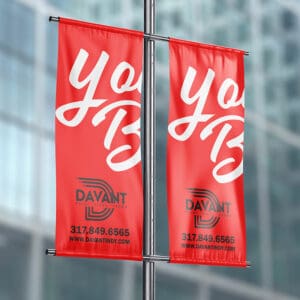
Vinyl banners are one of the most popular and versatile outdoor signage options for a reason; they’re relatively affordable, can be produced quickly, and work for everything from storefront promotions to event backdrops to job site signage. But vinyl isn’t all created equal.
For outdoor summer use, you want a banner printed on a heavyweight vinyl — typically 13 oz or higher — with UV-resistant inks and a reinforced hem with grommets at regular intervals. The weight matters because heavier vinyl resists tearing in the wind. UV-resistant inks matter because standard inks can begin to fade visibly within a few weeks of direct sun exposure. The reinforced hem and grommets matter because that’s where banners almost always fail first — a standard hem with widely spaced grommets will start to tear from the anchor points when wind gets behind it.
If a banner is going to be displayed for more than a few weeks in a fixed outdoor location, it’s also worth asking about mesh vinyl. Mesh banners have small perforations throughout the material that allow wind to pass through rather than build pressure behind the sign — significantly extending the life of the banner and reducing stress on mounting hardware.
Rigid Signage: Choosing the Right Substrate
For yard signs, A-frames, and mounted exterior panels, the substrate — the material the sign is printed on or applied to — determines how it holds up over time. Corrugated plastic, commonly called Coroplast, is a popular choice for short-term signage like real estate signs and event directionals. It’s lightweight and inexpensive, but it’s not designed for extended outdoor display in harsh conditions. Prolonged UV exposure fades the material itself, and the hollow fluted construction can trap moisture and degrade from the inside out.
For signage intended to last a full season or longer, aluminum composite material — often referred to as Dibond — is a significantly better option. It’s rigid, weather-resistant, holds color well, and doesn’t warp or absorb moisture the way some substrates do. It costs more than Coroplast, but for a sign that will represent your business for months at a time, the difference in longevity more than justifies the cost.
HDU foam and PVC board are also worth knowing about. Both are commonly used for dimensional and routed signage, and both hold up well in outdoor applications when properly sealed and finished. If you’re investing in a sign that’s meant to be a permanent or semi-permanent fixture outside your business, these materials offer durability and a more polished, professional appearance than flat-printed alternatives.
Lamination and Finishing: The Details That Protect Your Investment
Even the best substrate or vinyl won’t perform at its best without proper finishing. Lamination adds a protective layer over printed inks that significantly extends their resistance to UV fading, moisture, and surface abrasion. For outdoor applications, a UV-protective overlaminate is worth the additional cost on almost any printed piece — it’s the difference between a sign that looks great through October and one that looks washed out by July.
Finish choice also matters more than people realize. Gloss laminates look great in photos and in shaded environments, but direct Indiana summer sunlight can create glare that actually reduces readability from a distance. A matte or satin finish often performs better for roadside and exterior signage because it maintains visibility across more lighting conditions throughout the day.
Ask These Questions Before You Order
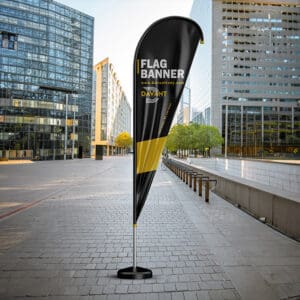
The best way to make sure you’re ordering signage that will hold up is to have an honest conversation with your print and signage partner before the order is placed. How long will the sign be displayed outdoors? What kind of exposure will it face — direct sun all day, partial shade, or covered? Will it be in a fixed position or moved around? Is wind a significant factor at the installation location?
These aren’t complicated questions, but the answers meaningfully change what materials and finishes make the most sense. A sign company that asks these things before recommending a solution is one worth working with. One that sells you the same Coroplast yard sign regardless of your use case will have you reordering sooner than you should.
Let’s Build Something That Lasts
Davant Indy produces outdoor signage for businesses throughout Greenfield and the greater Indianapolis area. Whether you need a banner for an upcoming event, permanent exterior signage for your location, or anything in between, we’ll help you choose materials that are built for how and where the sign will actually be used.
Contact us online or call us at (317) 849-6565 to get started.